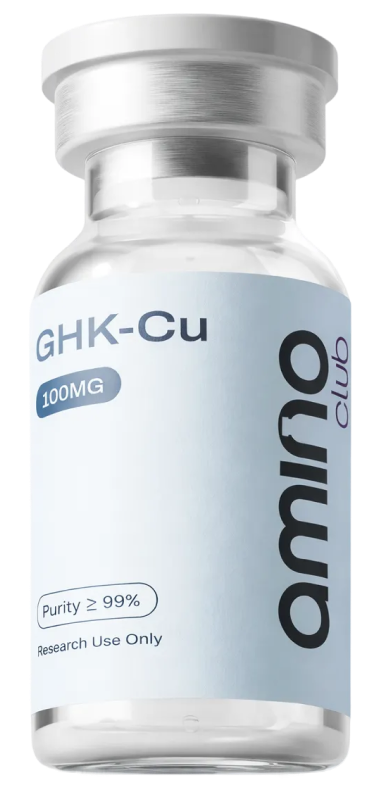

GHK-Cu
The GHK-Cu from the certified Amino Club laboratory catalog is supplied as an ultra-high purity analytical research compound in a hermetically sealed pharmaceutical-grade borosilicate glass vial. Manufactured in ISO/IEC 17025 accredited analytical environments, this premium research chemical guarantees uncompromised sequence purity, reproducible stoichiometric formulation, and verified chemical integrity for academic, clinical, and institutional investigators worldwide. Every batch undergoes exhaustive multi-point testing protocols, providing researchers with an exceptional baseline standard for complex in vitro cell culture models, receptor binding affinity assays, and biochemical pathway investigations.
Listing Details & Specifications
| Specification / Feature | Details |
|---|---|
| Compound Name | GHK-Cu |
| Molecular Classification | Glycyl-L-Histidyl-L-Lysine Copper Complex (GHK-Cu) (CAS: 89030-95-5) [MW: 340.38 g/mol (free peptide)] |
| Analytical Purity (HPLC) | ≥99.0% (RP-HPLC ISO 17025) |
| Physical Appearance | Deep Blue Lyophilized Powder Cake |
| Unit Configuration | Single Sterile Borosilicate 3mL Crimp-Sealed Vial |
| Verification Standards | ISO/IEC 17025 Accredited HPLC Purity & ESI-MS |
| Solvent / Carrier Medium | Bacteriostatic Water (0.9% Benzyl Alcohol) or Amino H2O |
| Storage Parameters | Room Temperature (Sealed); -20°C Long-Term |
| Dissolution Dynamics | Rapid, complete dissolution in aqueous media |
| Primary Research Focus | Extracellular matrix synthesis, dermal tissue remodeling, and collagen gene transcription |
Formulation, Synthesis & Analytical Architecture
Engineered to satisfy demanding scientific benchmarks, GHK-Cu holds a distinguished place within our specialized Research Peptides category. Synthesized utilizing automated solid-phase peptide protocols and refined through multi-pass preparative reverse-phase high-performance liquid chromatography, this formulation exhibits extraordinary chemical purity and minimal sequence truncation impurities. Critical manufacturing steps, including protecting group cleavage, counter-ion exchange, and aseptic filtration, are conducted within climate-regulated cleanroom facilities. The resulting high-density matrix demonstrates superb thermodynamic stability, safeguarding structural fidelity across complex in vitro and laboratory analytical frameworks.
Laboratory Handling, Delivery Protocols & Experimental Integration
Establishing disciplined laboratory handling procedures is essential to preserving active peptide configurations during testing. For GHK-Cu, researchers should ensure proper dispensing protocols under a certified laminar flow hood utilizing sterile equipment. When working with lyophilized presentations, introduce sterile reconstitution media slowly along the interior glass wall of the borosilicate container, swirling gently until completely clarified while avoiding vigorous mechanical agitation or vortexing. For precision mist solutions, prime the metered actuator prior to initial use and ensure consistent droplet distribution across experimental target media. Maintaining controlled environmental parameters and portioning stock solutions into single-use aliquots prevents repeated temperature fluctuations that could compromise molecular stability across serial experimental replicates.
Comparative Analysis & Synergistic Catalog Pairings
When constructing multi-phase investigative protocols, GHK-Cu exhibits distinct pharmacodynamic and structural characteristics that pair synergistically with other core compounds across our catalog. In comparative laboratory trials, researchers frequently cross-reference data against MOTS-C to examine differentiated receptor kinetics, evaluate parallel cellular responses alongside CJC-1295 / Ipamorelin (No DAC), and establish robust calibration benchmarks using PT-141 Research Mist. These synergistic combinations provide scientific teams with the versatility required to model complex biological interactions, elucidate dual-pathway kinetics, and achieve reproducible data across diverse experimental setups.
Storage Stability, Cold-Chain Maintenance & Handling
To maintain optimal chemical stability and potency over prolonged investigational timelines, containers of GHK-Cu must be stored in accordance with certified laboratory specifications. Sealed lyophilized vials should be maintained at -20°C in a desiccated storage freezer completely protected from light and ambient moisture, while pre-solubilized research mists should be kept refrigerated between 2°C and 8°C. Once reconstituted or opened, aqueous peptide solutions maintain peak activity for up to twenty-eight days under refrigeration. For long-term longitudinal studies spanning multiple months, prepare calibrated frozen aliquots at -80°C, thawing individual containers immediately prior to assay execution to preserve complete peptide integrity throughout subsequent analysis.
Analytical Quality Assurance & Verification Protocol: Automated analytical workflows confirm molecular weight congruence and chromatographic peak symmetry across every prepared lot. Controlled cryogenic sublimation maintains tertiary structural integrity and yields uniform lyophilized cakes with minimal residual solvent content. Quantitative amino acid evaluation validates exact stoichiometric ratios and precise net peptide concentrations prior to secondary packaging. Aseptic nitrogen.
Batch Verification, Analytical COA & Compliance Notice
Every production batch of GHK-Cu is accompanied by a lot-specific Certificate of Analysis issued by an independent ISO/IEC 17025 accredited laboratory, documenting full analytical verification via RP-HPLC purity chromatography, mass spectrometry (ESI-MS), endotoxin screening, and heavy metal testing. All products offered under this listing are strictly intended for in vitro laboratory research and scientific educational purposes only. They are not intended for human consumption, clinical diagnostic administration, veterinary use, or compounding pharmacy production. All procurement must adhere to verified institutional handling standards through the authorized Amino Club research distribution network.
Related products